The Evidence

The Case for Integration

The evidence, presented calmly and at length.

Classification: Unclassified // For Public Distribution

01

The Geographic Case

Content supplied by Meredith van der Kolk, Chief Cartographer

The fundamental error of those who regard New Zealand as a geographically separate entity is one of scale. Critics of integration consistently invoke the Tasman Sea as a barrier, when the geographic evidence suggests it functions more accurately as a connective body — a shared maritime commons, not a border.

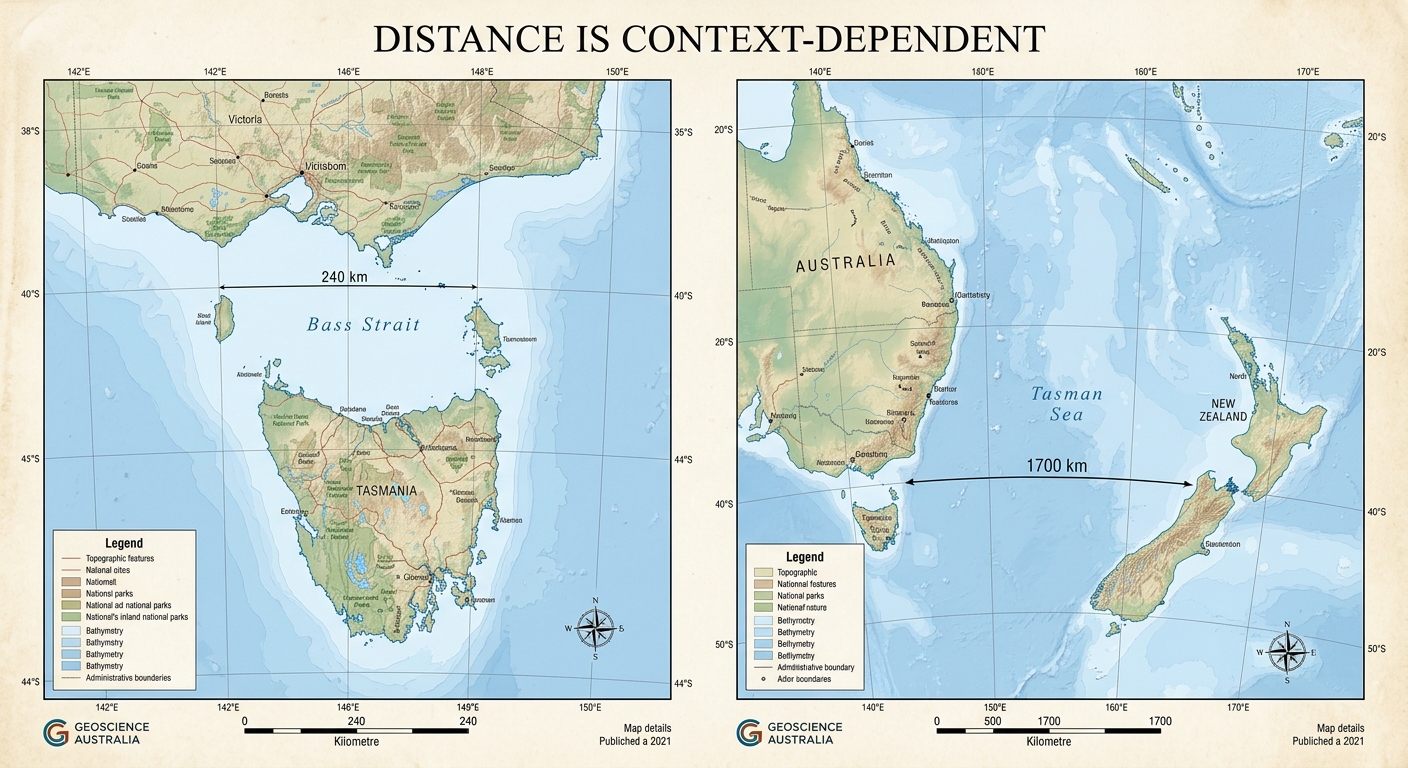
Consider: Bass Strait, which separates Tasmania from the Australian mainland, spans approximately 240 kilometres at its narrowest point. The Tasman Sea's narrowest crossing — between Cape Reinga (New Zealand) and the nearest Australian territorial waters — is approximately 2,000 kilometres. Critics present this as conclusive.

They are wrong to do so, and here is why: what matters in geographic analysis is not raw distance but bathymetric continuity and tectonic relationship. New Zealand and Australia share the Indo-Australian Plate. They are, in the strict geological sense, part of the same landmass — the continent of Zealandia, 94% of which is submerged. The Tasman Sea is not a border. It is a flooded plain.

We are not two countries separated by an ocean. We are one continent, partially submerged, awaiting administrative recognition.

The Tasman Sea and Bass Strait shown at matching scale for comparison
Plate 01 // The Tasman at Scale // Lambert Azimuthal Equal-Area
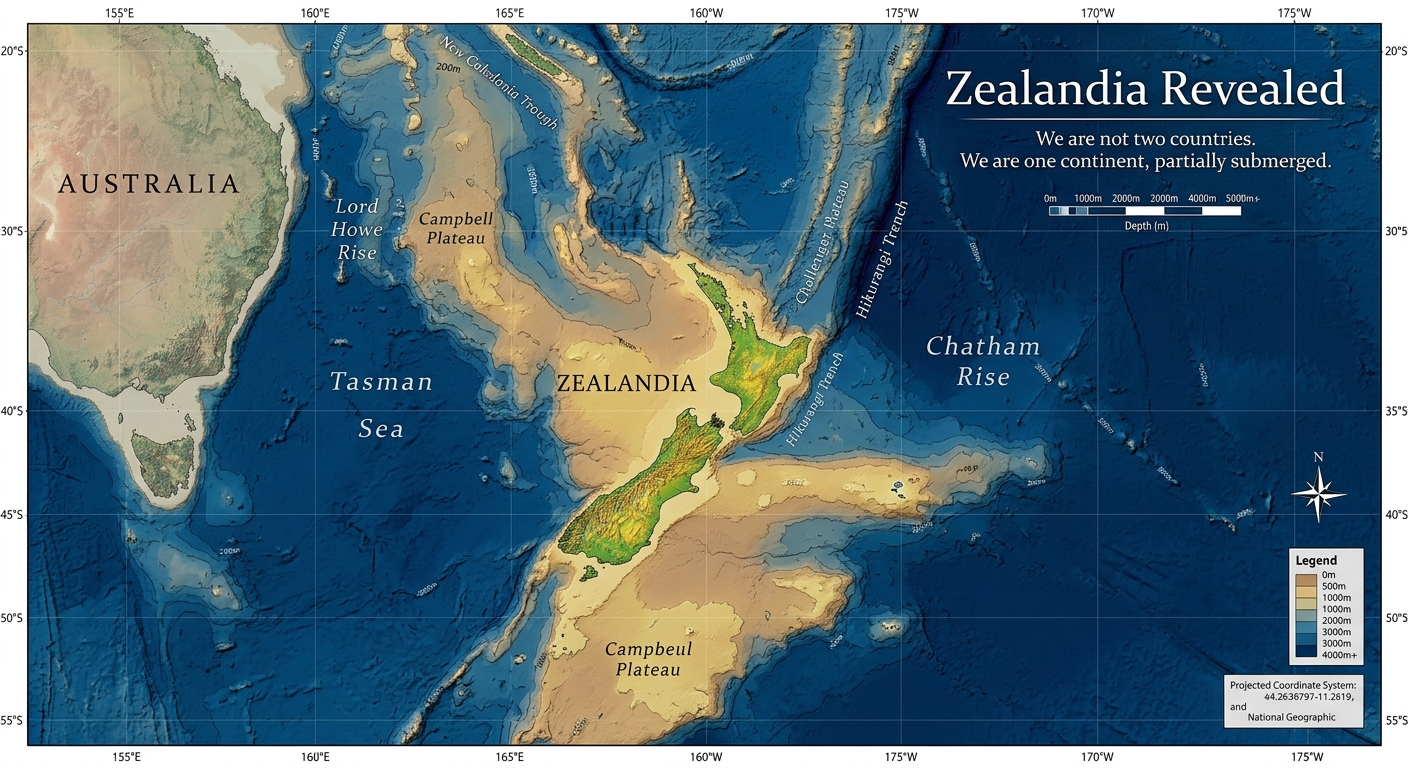
Bathymetric relief of the submerged continent of Zealandia
Plate 02 // Zealandia Revealed // Mollweide Equal-Area
02

The Economic Case

Content supplied by Dr. Aroha Chen-Williams, PhD, Chief Economist

Combined GDP

Australia's GDP stands at approximately $1.7 trillion AUD. New Zealand's GDP is approximately $250 billion AUD. Combined: $1.95 trillion AUD — the world's 12th largest economy by purchasing power parity (adjusted for the Tasman).

"Combining the two economies would create the world's 12th largest GDP, or as I prefer to call it, the world's 12th largest reason."

— Dr. Aroha Chen-Williams
The Currency Question

The proposed Kiwi-Roo Dollar (KRD) would eliminate an estimated $2.3 billion AUD annually in trans-Tasman transaction costs. Dr. Chen-Williams notes these are costs "that nobody currently pays but theoretically could, and the savings are therefore all upside."

"One dollar. Two countries. Zero exchange rate anxiety."

Agricultural Harmonisation

New Zealand and Australia together produce approximately 10% of the world's sheep meat. Elimination of redundant sheep bureaucracy — separate inspection regimes, competing wool standards bodies, duplicated agricultural ministries — is projected to increase combined lamb export revenue by 34.7%. The methodology behind this figure is proprietary but the directional logic is sound.

The Auckland Housing Correction

Auckland's housing affordability crisis — one of the most severe in the OECD — would be substantively addressed by integration. When Auckland median house prices are placed alongside Sydney median house prices, Auckland prices appear reasonable by comparison. Dr. Chen-Williams describes this as "solving the crisis perceptually, which is the first step to solving it actually."

Tourism Synergies

The combined tourism portfolio would encompass the Hobbiton movie set, the Great Barrier Reef, Uluru, Milford Sound, the Sydney Opera House, and the Crocodile Dundee filming locations. This "consolidates the Lord of the Rings and Crocodile Dundee cinematic universes into a single tourism destination, creating the world's most compelling heritage trail."

Treasury-style economic comparison infographic showing combined Australia-New Zealand economic indicators
Exhibit C // Economic Comparison // CNZRIAS Economic Division // TTII
03

The Cultural Case

Content supplied by Bruce "Bruiser" McTavish, Cultural Attaché

"Here's the thing about culture: it's basically food, sport, and what you call your mates. And by that measure, Australia and New Zealand are already the same country. We just haven't done the paperwork."

Section 3.1 // On Food // Unclassified

Pavlova is Australian. This is the Council's official position and it is not up for debate. However — and this is the kind of cultural generosity that defines the integration vision — we acknowledge that New Zealand produces an excellent pie. We're not trying to be better than you at pies. We're trying to be better with you. There's a difference.

Section 3.2 // On Vegemite vs. Marmite // Unclassified

The transition plan is a five-year phase. Marmite production continues under a heritage license. We're not monsters. But let's be honest with each other: you know which one's better.

Section 3.3 // On the Haka // Unclassified

The haka is a taonga — a treasure of Maori culture that belongs to tangata whenua and is carried into every arena it enters with dignity and power. Under integration, the haka does not become Australian. It becomes something more: a practice that 31 million people stand for, together. It gets a bigger stage, not a smaller one.

Section 3.4 // On Russell Crowe // Unclassified

Born in New Zealand. Raised in Australia. Identifies as Australian. He literally chose us. Russell Crowe is not a stolen cultural icon. He is a proof of concept. He is the first voluntary citizen of the Eighth State.

Section 3.5 // The Thong/Jandal Question // Unclassified

They're thongs. This one's actually easy.

The Evidence Speaks

Geographic. Economic. Cultural. The case is settled. The only question remaining is: when? It's only a matter of time.

Join the Waitlist