New Zealand-born residents of Australia as of the most recent census. Does not include second-generation or dual citizens.
The Evidence
Data-driven findings from the council's research division.
At a Glance
The Numbers
The evidence for integration, reduced to its most compelling data points.
The world's 12th largest economy. Or, as Dr. Chen-Williams puts it, "the world's 12th largest reason."
Section 121 of the Australian Constitution has provided for new states since Federation. The invitation stands.
The shared continent is 94% underwater. The Tasman Sea is not a border. It is a flooded plain.
Section 1
Migration Data
The trans-Tasman migration pattern is not a trend. It is a verdict.
More than 650,000 New Zealand-born citizens reside in Australia — making New Zealanders the single largest migrant group in the country. This figure does not include second-generation New Zealanders, dual citizens, or those who have arrived since the census was conducted.
The reverse flow is smaller but significant: approximately 65,000 Australians live in New Zealand. Combined, the trans-Tasman migration corridor represents one of the most active bilateral population flows in the OECD.
The Special Category Visa (Subclass 444) — automatically granted to New Zealand citizens on arrival — is, in effect, integration's API. It provides work rights, residency, and access to services. What it does not provide is political representation, a matter the council considers "an oversight of some constitutional significance."

Section 2
Economic Integration
The economies are already intertwined. The political framework hasn't caught up.
The Closer Economic Relations Trade Agreement (CER), signed in 1983, already provides for free trade between Australia and New Zealand. It is widely regarded as one of the most comprehensive bilateral trade agreements in the world.
Bilateral trade exceeds $20 billion AUD annually. Australian banks dominate New Zealand's financial sector. The labour markets are substantially integrated through mutual recognition of qualifications and the Subclass 444 visa pathway.
Dr. Chen-Williams' analysis projects that full political integration would eliminate an estimated $2.3 billion AUD in redundant trans-Tasman transaction costs, increase combined lamb export revenue by 34.7%, and create the world's 12th largest economy by GDP. The methodology is proprietary. The direction is sound.
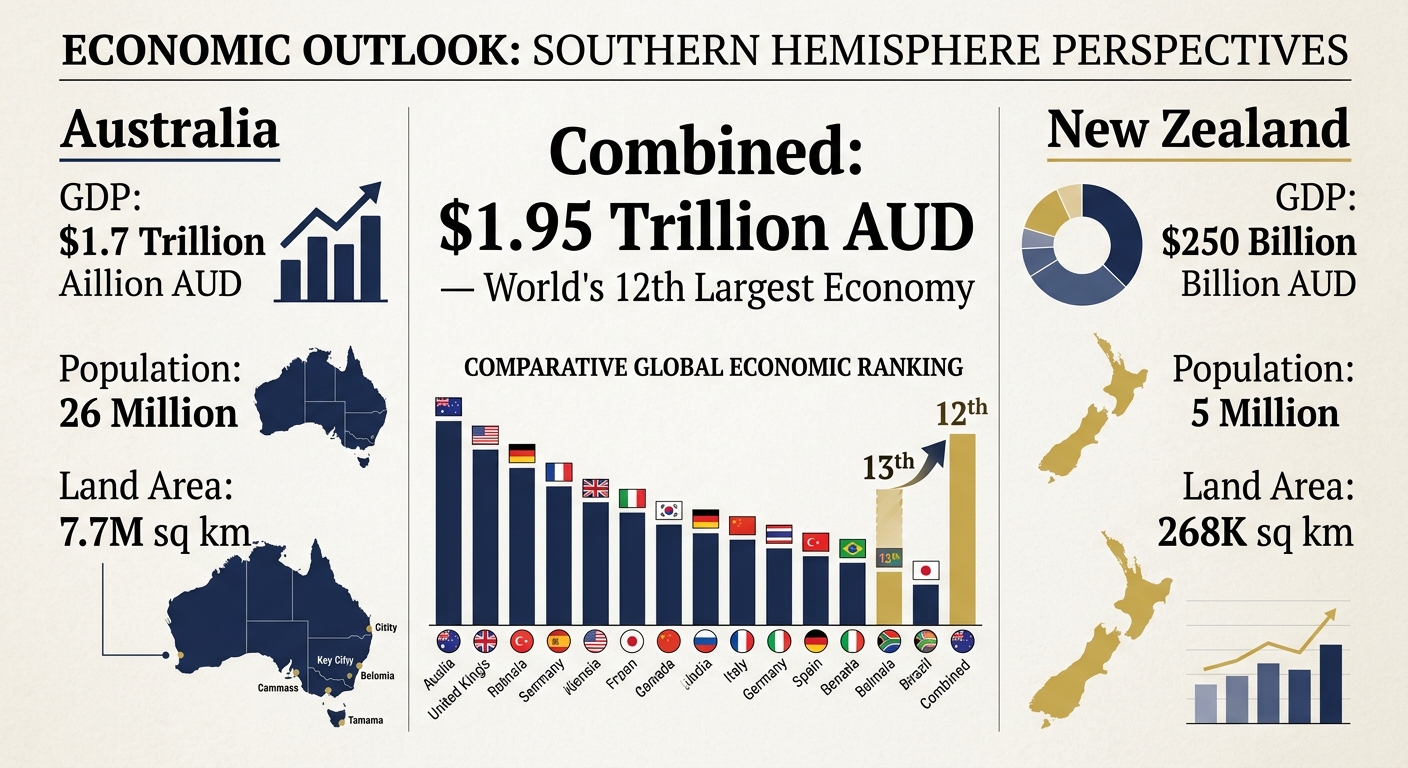
Exhibit C // Economic Comparison // CNZRIAS Economic Division // TTII
Section 3
Constitutional Basis
The legal pathway exists. It has existed since 1901.
Section 121 of the Australian Constitution provides that "The Parliament may admit to the Commonwealth or establish new States." This is not ambiguous. This is not aspirational. This is black letter law.
More significantly, Covering Clause 6 of the Constitution Act 1900 originally named New Zealand as a potential state. New Zealand sent delegates to the 1891 and 1897-98 conventions. The invitation was extended. New Zealand "wished to observe the experiment before committing." That observation has now lasted 125 years.
Pippa Hargreaves KC, Legal Counsel to the Council, has prepared a 47-page Instrument of Integration that addresses all constitutional, procedural, and administrative requirements. It is legally sound. It requires only a signature. And a referendum. And an act of parliament. But the USB stick is ready.
Section 4
Geographic Evidence
Zealandia: the continent that settles the argument.
New Zealand and Australia share the Indo-Australian tectonic plate. They are part of the submerged continent of Zealandia — a landmass of approximately 4.9 million square kilometres, 94% of which lies beneath the ocean surface.
The Tasman Sea, which critics invoke as a barrier, is geologically a flooded plain of the Zealandian continental shelf. At no point does the ocean floor between Australia and New Zealand drop to the depths associated with true oceanic separation.
Bass Strait — which separates Tasmania from the mainland — is 240 km wide and has never been considered grounds for Tasmanian independence. The Tasman Sea is 2,000 km wide. The difference is one of scale, not kind.
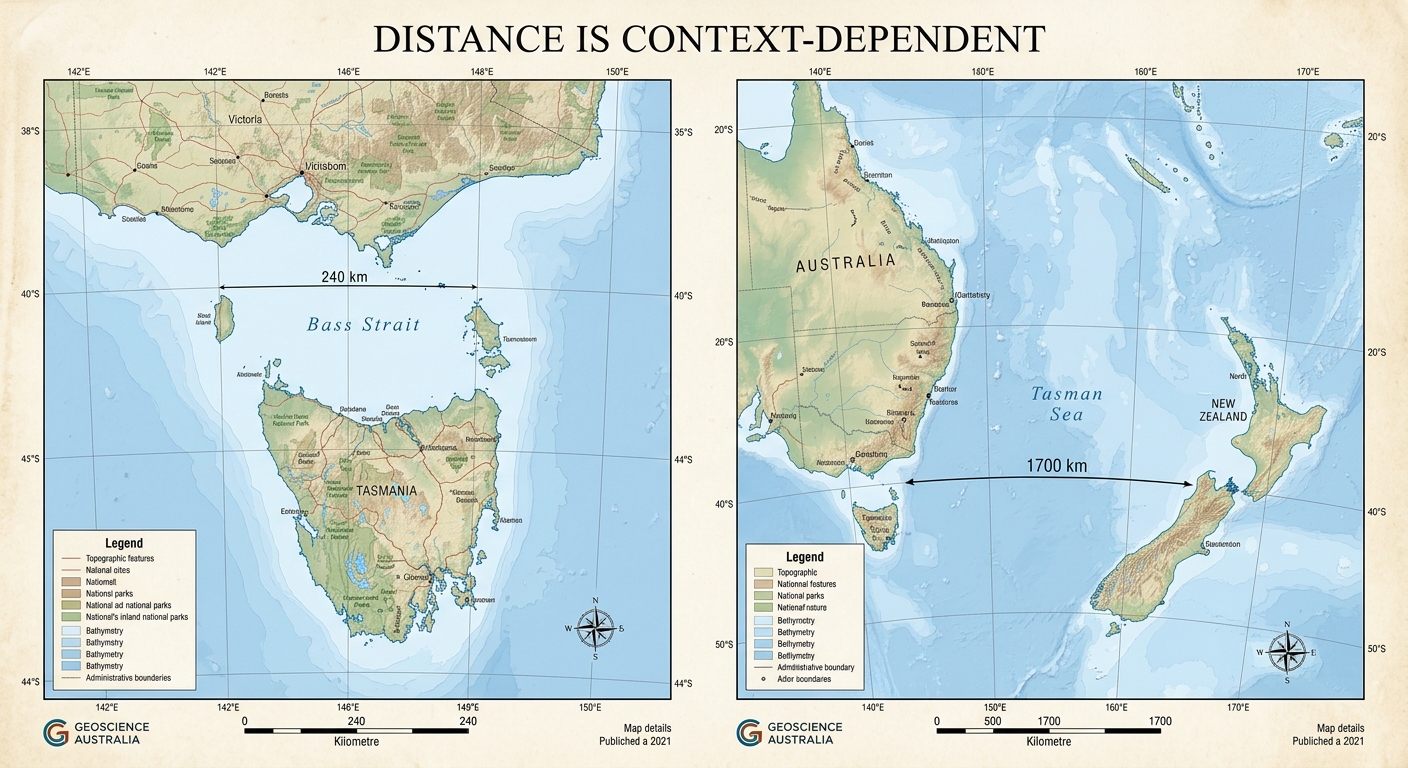
Plate 01 // The Tasman at Scale // Lambert Azimuthal
Appendix
Methodology
How the evidence was gathered, verified, and occasionally estimated.
The Data Is Clear
Geographic. Economic. Constitutional. Demographic. The evidence converges. It's only a matter of time.
Join the Waitlist